
UBINODES — RESEARCH 2026
THE FOUR-BURNER DECENTRALISED ORGANISATION.
How distributed structures change the knobs on the four-burner stove of Work, Family, Friends, and Health — and what they cannot change.
TL;DR — This research article applies the Four-Burner Theory to decentralised organisations. It argues that distributed structures can lower the baseline intensity of the Work burner and make work more shareable, but cannot add a fifth burner or extend the finite day. Sections 01–02 set up the question; Section 03 weighs where decentralisation helps and harms; Section 04 gives five design principles for practitioners building node-based teams.
Estimated reading time: full document 12 min · Design principles (Section 04) only: 6 min.
01. Abstract.
This paper examines decentralised organisations through the lens of the Four-Burner Theory, which conceptualises individual life as four competing domains — Work, Family, Friends, and Health — served by a fixed “stove” of limited time and energy.[1] The central question is not whether decentralisation is more efficient than hierarchy, but whether it meaningfully alters the structural constraint that no individual can run all four burners at full heat simultaneously.[1] Drawing on role theory, self-determination theory, boundary theory, and recent work on work–life fit, the paper argues that decentralised structures can reduce the baseline intensity and rigidity of the Work burner (by increasing autonomy and redistributability), but cannot add a fifth burner or expand the finite temporal surface on which all domains rest.[3][4] Under poor implementation, decentralisation can exacerbate role ambiguity, boundary blurring, and work–family conflict, raising the “heat” of all burners rather than lowering it. The paper identifies design conditions under which decentralised organisations can make the Four-Burner constraint more manageable — primarily by improving control over the Work burner and enabling genuinely shared responsibility for work — and proposes a research agenda to test these claims empirically.
Keywords: Four-Burner Theory · decentralised organisation · autonomy · work–life fit · role strain · boundary theory
02. Introduction.
The Four-Burner Theory describes a structural limitation most people recognise intuitively: a human life has four major domains — Work, Family, Friends, and Health — and a finite “stove” of attention, energy, and time on which they must all be cooked.[1] The theory does not recommend sacrifice; it observes that running all four burners at maximum intensity at the same time is not possible, in the same way that a domestic four-burner stove cannot accommodate four large pots simultaneously.[1] The constraint is not personal but systemic: the physical, temporal, and cognitive surface is limited.
In parallel, organisational research over the past three decades has documented the rise of decentralised, self-managing, and non-hierarchical structures as alternatives to traditional management hierarchies.[5][6] These models — Holacracy, sociocracy, self-managing teams, four-day-week experiments, remote-first companies — share a core promise: by distributing authority and increasing autonomy, they claim to improve both organisational adaptability and individual well-being.[5][7][8] Empirical findings are mixed. Autonomy and flexible work arrangements are reliably associated with higher job satisfaction, engagement, and perceived work–life balance, but only under specific conditions of role clarity, supportive climate, and boundary control.[4][7][17]
This paper connects these two strands explicitly. Rather than asking whether decentralisation “works” in general, it asks a more specific and, for individuals, more practical question:
To what extent, and under what conditions, can a decentralised operating model make the Four-Burner constraint easier rather than harder to live with?
Put differently: if individual lives are constrained by a fixed four-burner stove, can organisational design change the quality of the knobs — the controllability, flexibility, and sharability of the Work burner — in ways that improve the overall configuration of Work, Family, Friends, and Health?
The contribution of this paper is threefold:
- It uses the Four-Burner Theory as a micro-level frame for evaluating decentralised organisations, making explicit how structural changes in work affect the individual’s allocation problem across life domains.
- It distinguishes clearly between what decentralisation genuinely changes (autonomy, redistributability, baseline Work intensity) and what it cannot change (the fixed temporal and energetic constraints of individual lives).
- It identifies design principles for decentralised organisations that allow the Four-Burner constraint to work in their favour — and warns where decentralisation, if poorly implemented, intensifies rather than alleviates the problem.
Section 03 analyses where decentralisation helps and where it creates new problems for the four burners. Section 04 turns that analysis into prescriptive design principles for practitioners.
Part 1 — WHAT DECENTRALISATION DOES TO THE FOUR BURNERS.
03. What Decentralisation Does to the Four Burners.
Decentralisation acts on the four burners in two opposite directions at once. Where it is well implemented, it makes the Work burner more controllable and more shareable. Where it is poorly implemented, it removes the boundaries that used to contain Work and leaves individuals to improvise them alone. The two subsections below set out each side; the third draws the distinction that reconciles them, and the fourth describes the one scenario in which structure changes the constraint most fundamentally.
03.1 Where Decentralisation Genuinely Helps.
03.1.1 Autonomy Reduces Role Conflict.
The most consistent finding in the work–life literature is that perceived control over one’s time — autonomy over when and how work is done — is a strong predictor of reduced work–family conflict and increased well-being.[4][7][10] Decentralised organisations, by design, distribute decision-making authority downwards, so that contributors have greater discretion over their tasks, schedules, and methods. In Four-Burner terms, the Work burner becomes a more responsive knob: it can be turned down without immediate sanction, turned up when required, and adjusted in timing to reduce direct collisions with the other three burners.
Self-determination theory explains this effect mechanistically. When work satisfies the basic needs of autonomy, competence, and relatedness, effort is internally endorsed rather than externally imposed.[3] The same number of hours at the Work burner consumes less psychological energy than equivalently long externally controlled work. This lowers the effective “heat cost” of Work and leaves more resources available for Family, Friends, and Health.
03.1.2 Autonomy as a Burnout Buffer.
Recent studies confirm that autonomy is not only associated with higher engagement, but also acts as a buffer against burnout and stress. Cross-sectional and longitudinal research finds that employees with higher decision latitude report lower emotional exhaustion and better work–life balance, even when workload is high.[4][7][11] Leaders with high autonomy and strong self-resources maintain better health and balance regardless of the proportion of time spent working from home.[4]
In a decentralised organisation where contributors can shape their workload, sequence tasks, and choose when to be “on” or “off” without constant managerial oversight, the Work burner can be run at lower subjective cost. This does not abolish the need to prioritise — the Four-Burner constraint remains — but the trade-offs become somewhat less severe. Running Work hot for a season does not deplete the system as quickly when the individual’s autonomy and intrinsic motivation are high.
03.1.3 Redistributability: The “Multiple Cooks” Effect.
A more structural advantage emerges when decentralisation is coupled with a role-based, documented operating model: the ability to redistribute work between people. In conventional organisations, crucial tasks are often tied to specific individuals; if those individuals step back, their Work burner simply goes cold and the work stalls. In a decentralised model built around clearly defined, documented roles, tasks can be reassigned or shared without collapsing the system.
Four-day-week trials illustrate this effect in practice. Organisations that reduced individual working time by 20% without loss of output did so by redesigning processes, cutting waste, and redistributing work across teams, not by expecting each person to compress the same workload into fewer hours.[12] These results come from coordinated pilots rather than settled, long-run practice, and should be read as promising early evidence rather than a proven steady state. Translated into Four-Burner language: the organisation found ways to maintain the total heat of the Work burner while allowing individual contributors to turn theirs down periodically — because others could step in.
03.2 Where Decentralisation Creates New Problems.
03.2.1 Remote Work and Boundary Blurring.
Decentralisation is often implemented in tandem with flexible and remote work. This combination is double-edged. Working from home can reduce commuting time, increase sleep, and improve perceived work–life fit — especially for workers who previously had little control over where and when they worked.[4][10] At the same time, research consistently documents increased boundary blurring, longer working hours, and reduced recovery when home and office share the same physical and digital space.[9][13][14]
Clark’s Work/Family Border Theory emphasises that physical and temporal boundaries between domains are key mechanisms for managing interference: leaving the office and commuting home signals a domain transition.[9] When work happens on the same devices and in the same rooms as family life and rest, those boundaries weaken. In Four-Burner terms, the Work burner no longer has a clear off-switch; it leaks low-level heat into the other burners in the form of evening emails, weekend “quick checks,” and constant mental availability.
03.2.2 The Autonomy Paradox and Role Ambiguity.
The autonomy that decentralised organisations offer can, under certain conditions, backfire. Studies of remote and flexible work highlight an “autonomy paradox”: workers with high autonomy sometimes end up working longer, not shorter, hours and experience more stress, not less, because they internalise expectations and struggle to self-limit.[14][20] When decentralisation is implemented without clear role definitions, explicit expectations, and supportive norms, autonomy becomes role ambiguity in disguise.
Role ambiguity is itself a well-documented driver of stress, burnout, and work–family conflict.[2][5] In the Four-Burner frame, role ambiguity makes the Work burner harder to regulate: because its demands are unpredictable and poorly bounded, it flares up unexpectedly, disrupting planned allocations to the other domains. A “flat” or decentralised structure without clear expectations does not liberate the individual from the Four-Burner constraint; it may instead intensify it.
03.2.3 The Boundary Management Skill Gap.
Boundary theory research shows that individuals differ markedly in their preferred and effective strategies for managing domain boundaries. Some are natural segmenters, keeping work and non-work domains distinct; others are integrators, comfortable with blending roles and switching frequently.[9][13][15] Decentralised, flexible, and remote arrangements implicitly require strong boundary management skills from everyone: the organisation no longer enforces boundaries through fixed hours and locations; each person must design and maintain their own.
This requirement creates an often-unacknowledged equity issue. Individuals with strong self-regulation and boundary skills thrive in high-autonomy, decentralised contexts; those without such skills are more exposed to overwork, conflict between domains, and burnout.[14][15] The organisation hands over the knobs, but not everyone is equally skilled at operating them. In Four-Burner terms, decentralisation increases the sensitivity of the Work burner’s controls, but does not guarantee that every cook is trained.
03.3 The Core Distinction: Conditions vs Constraint.
The critical clarification that resolves much of the confusion around decentralisation and “work–life balance” is this:
Organisational structure operates at the level of conditions. The Four-Burner constraint operates at the level of the individual.
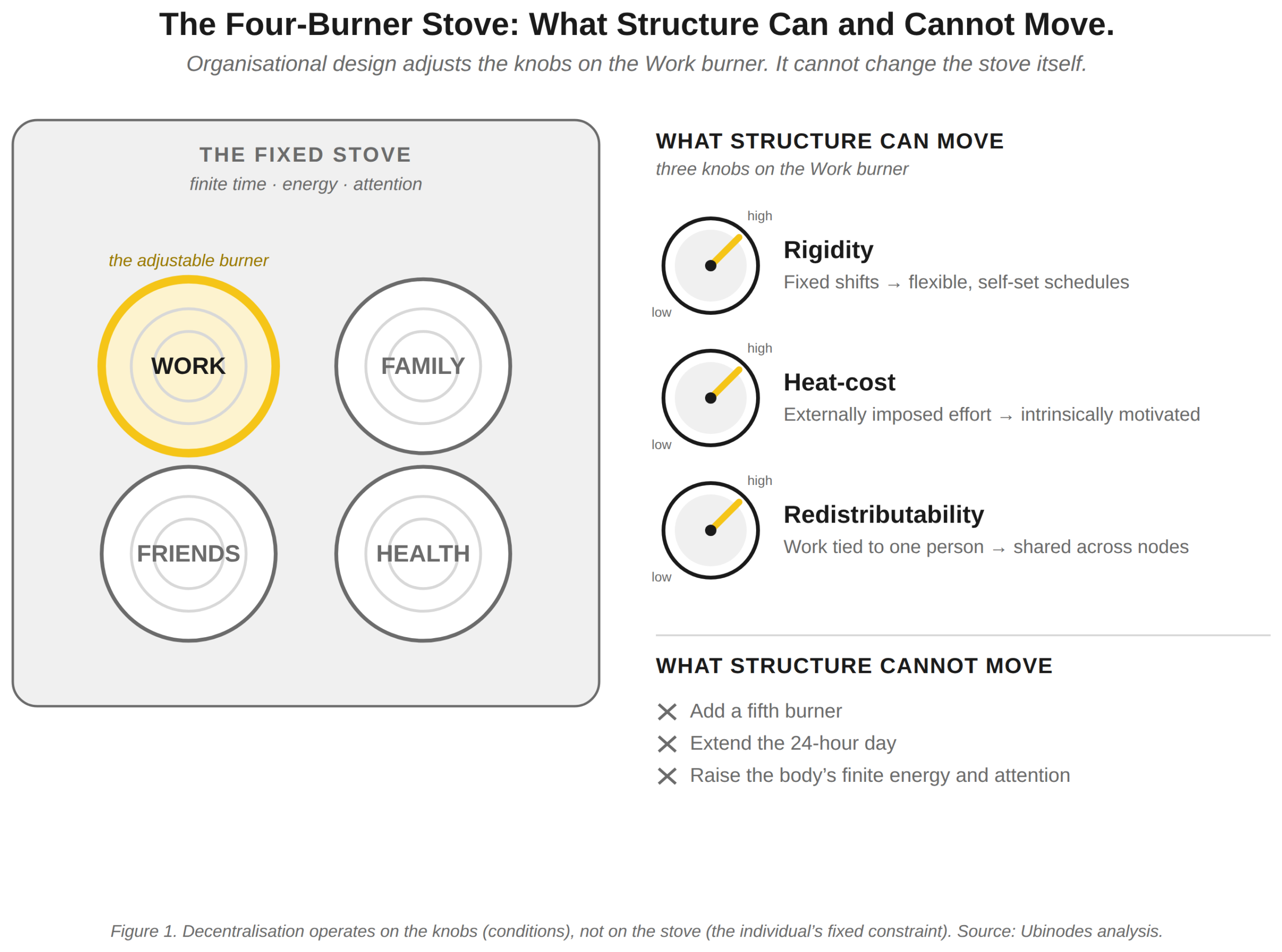
No organisational structure — hierarchical, decentralised, hybrid, or otherwise — can add a fifth burner, expand the length of the day, or increase the basic physiological and cognitive limits of the human organism. The 24-hour day, the need for sleep, the finite pool of attention and emotional energy: these are constants.
What organisational structure can do is influence:
- how rigid the Work burner’s settings are (fixed shifts vs flexible schedules);
- how costly it is to run Work at a given level (externally imposed vs intrinsically motivated effort);
- how redistributable work is when one person needs to turn down their burner.
A decentralised organisation with good design can therefore reduce the minimum baseline at which Work must run, make its peaks more discretionary, and provide mechanisms for sharing its load. It cannot abolish the fact that turning Work up very high for very long will still require turning something else down.
Recent work on the shift from “work–life balance” to “work–life fit” captures this distinction: the emerging models emphasise personalised flexibility, organisational trust, and adaptive processes that align work patterns with individual circumstances.[10][16] They do not deny the underlying constraint; they seek to configure conditions such that the constraint becomes livable.
03.4 The Multi-Cook Scenario: Sharing the Work Burner.
There is, however, one scenario in which organisational structure changes the practical shape of the constraint more fundamentally: when multiple people genuinely share responsibility for the Work domain.
In most conventional arrangements, an individual is the primary or sole owner of their workload. If they reduce their effort, their queue simply grows, or colleagues cover informally at personal cost. In a decentralised organisation designed around redistributable roles, shared knowledge, and explicit coverage mechanisms, a contributor can turn down their own Work burner because another node can temporarily step in to handle part of that domain without catastrophic consequences.
This does not violate the Four-Burner constraint; it redistributes where the Work heat is generated. The organisation becomes more like a professional kitchen: multiple cooks, overlapping competencies, and station coverage. The key difference is at the level of individual experience: the person who needs to tend to Family, Friends, or Health can do so knowing that Work will continue — not indefinitely, and not without coordination, but without uniquely resting on them.
Whether any given decentralised organisation actually implements this multi-cook scenario is an empirical question. It depends on:
- the quality of its role definitions and documentation;
- the robustness of its knowledge-transfer and backup mechanisms;
- the level of trust that stepping back will not be penalised;
- and the degree to which redistribution is treated as normal governance rather than as emergency improvisation.
Section 04 turns these conditions into prescriptive design principles: what a decentralised organisation must do to ensure that the Four-Burner Theory works in its favour rather than against it, both for the organisation and for the individuals whose lives are cooked on its stove.
Part 2 — DESIGN PRINCIPLES.
04. Design Principles: Making Decentralisation Work with the Four Burners.
The analysis in Section 03 yields a practical conclusion: decentralisation is neither a cure nor a curse for the Four-Burner constraint — it is a set of conditions that can be designed well or badly. The five principles below translate the conditions identified above into prescriptive design choices for node-based, self-managing teams.
04.1 Principle 1 — Lower the Default Heat of Work.
The first objective of a decentralised organisation, seen through the Four-Burner lens, is to reduce the baseline intensity of the Work burner without collapsing output. This means combining real autonomy with clear outcomes.
04.1.1 Make Autonomy Real but Bounded.
Research on self-managing organisations shows that autonomy increases engagement and reduces strain when it is paired with clear roles and expectations, not when it is limitless and undefined.[17][18] The operative design pattern is high autonomy, high clarity:
- Define outcomes, not hours: each role specifies what must be delivered and to what standard, rather than prescribing fixed times and methods.
- Give nodes discretion over how and when to achieve those outcomes within agreed time frames.
- Make decision rights explicit: who can decide what, without further permission.[18][19]
In Four-Burner terms, this lowers the default setting of the Work burner: contributors can choose when to concentrate heat, and when to cool it, as long as outcomes are met.
04.1.2 Protect Non-Work Time Explicitly.
Autonomy alone is not enough; without limits, it becomes the autonomy paradox where people overwork themselves.[20][21] The organisation must make “off” time structurally visible:
- Define no-contact windows (e.g. evenings, weekends, personal days) where messages may be sent but no response is expected.
- Discourage “always-on” channels for routine coordination; use asynchronous tools with clear service-level expectations instead of implicit immediacy.
- Track meeting load and after-hours work as real metrics, not just throughput.
From a Four-Burner perspective, this is equivalent to reinstalling an off-switch on the Work burner so that Family, Friends, and Health can run without constant background heat.
04.2 Principle 2 — Engineer Redistributability.
The second objective is to ensure that when an individual needs to reduce their Work burner, the work itself can be shared rather than simply paused or dumped.
04.2.1 Roles, Not People, as Units of Work.
Distributed organisations that thrive treat roles — not individuals — as the primary units of accountability.[18][27]
- Each role has a clear purpose, defined responsibilities, and explicit decision authority.
- Individuals can hold multiple roles; roles can be reassigned without re-writing job descriptions.
- Critical roles are mapped so that at least two nodes can perform them, even if at different levels of mastery.
This architecture enables the “multi-cook” scenario described earlier: the Work burner at the organisational level keeps running because other hands can take a pan when one cook steps back.
04.2.2 Documentation and Knowledge Transfer as Core Operations.
Without robust documentation, redistributability is an illusion: work remains tied to whoever “knows how things are done.”[18]
- Make documentation of processes, decisions, and client context a first-order deliverable, not optional admin.
- Embed knowledge-transfer steps in every role exit, extended absence, or major change.
- Treat undocumented critical knowledge as a governance problem: the organisation is depending on a hidden hierarchy of indispensable individuals.
From the Four-Burner vantage point, documentation is what allows the Work domain to be truly shared: knowledge is no longer a single person’s pan on the stove.
04.2.3 Normalise Load Redistribution.
Redistribution should be a routine governance act, not a last-minute favour:
- Use regular load-check rituals (e.g. weekly) where nodes can flag overload and request redistribution.
- Empower governance processes to reassign roles temporarily without social stigma.
- Track redistribution events to spot structural patterns (e.g. the same node or role repeatedly overloaded).
The design goal is that an individual who needs to turn down Work for a period can do so without silently overloading colleagues — the organisational equivalent of moving a pot to another active burner rather than letting it boil over.
04.3 Principle 3 — Support Boundary Skills; Do Not Assume Them.
Decentralisation and remote work shift boundary management from the organisation to the individual. If left unsupported, this amplifies the Four-Burner problem for those least equipped to handle it.[13][23]
04.3.1 Make Boundary Management a Teachable Skill.
Boundary theory and recent remote-work studies show that segmenting and integrating are learnable behaviours, not fixed traits.[13][15][22] Organisations can:
- Offer practical training on boundary tactics (e.g. start-/end-of-day rituals, device rules, scheduling techniques).
- Provide templates for “boundary agreements” where nodes specify when they are reachable and for what types of issues.
- Encourage experimentation: some roles may be best served by strong segmentation, others by thoughtful integration.
In Four-Burner language, this is giving each cook instructions on when and how to switch burners, rather than assuming everyone arrives knowing how to manage four at once.
04.3.2 Design Tools and Norms That Respect Boundaries.
Constant connectivity and poorly configured tools erode boundaries regardless of personal preferences.[13][22]
- Configure defaults to reduce interruption: batched notifications, quiet hours, delayed sends.
- Establish norms about channel meaning (e.g. chat for non-urgent, phone for urgent) so that a message’s urgency is not ambiguous.
- Encourage leaders and lead nodes to model boundary-respecting behaviour (not sending non-urgent requests at odd hours, honouring stated availability).
This reduces the “ambient heat” of Work — the low-level simmer that never quite turns off — and makes the other three burners easier to tend.
04.4 Principle 4 — Acknowledge Asymmetry and Design for It.
Even with perfect structure, some roles and people will carry structurally hotter Work burners: rare expertise, regulatory responsibility, key client stewardship. Pretending otherwise is a recipe for silent overload.
04.4.1 Map Structural Hot Spots.
- Identify roles that are non-fungible (hard to replace quickly) and tasks with high failure cost.
- Assess which nodes are consistently over-requested, even in a decentralised system.
- Use this map to anticipate where the Four-Burner constraint will bite hardest.
04.4.2 Compensate Rather Than Deny.
Design compensations rather than ignoring asymmetry:
- Build backup capabilities for hot roles, even if at lower depth, to reduce pressure on the primary node.
- Provide extra recovery time, lighter periods, or reduced responsibilities in other domains to those carrying predictable surges.
- Make these compensations explicit in the operating manual so they are seen as structural design, not personal favour.
From the Four-Burner perspective, this is recognising that some stations in the kitchen will always run hotter — and designing rota, staffing, and recovery accordingly, instead of pretending all burners are equally easy.
04.5 Principle 5 — Embed Trust and Conflict Resolution into the Structure.
Finally, the node model depends on trust: without it, autonomy collapses into anxiety and informal hierarchy reasserts itself.[18][24][25]
04.5.1 Trust as a Designed Behaviour.
Trust does not emerge solely from slogans; it is built by predictable patterns:
- Transparency: information about roles, decisions, and performance is visible so that people can act without guessing.[24]
- Clear escalation paths: when something goes wrong, there is a known, fair process rather than ad-hoc politics.
- Shared purpose: work is framed around a mission that is larger than any node’s preferences, anchoring autonomy in a common direction.[18][25]
04.5.2 Conflict Resolution as Normal Governance.
Unresolved conflict is a common failure mode in self-managing systems; it quietly rebuilds hierarchy as people seek “someone above” to arbitrate.[18][26]
- Make direct resolution the default expectation: nodes are supported to address issues with each other, not triangulate.
- Provide lightweight mediation formats facilitated by a lead node or rotating role.
- Link recurring conflict themes back into governance: if the same kind of clash repeats, it signals an operating-manual gap.
In Four-Burner terms, conflict that is left to fester behaves like a gas leak: invisible at first, then explosive. Designing in conflict-handling mechanisms prevents small misalignments from consuming disproportionate energy that could have fuelled the other burners.
04.6 Summary of Design Logic.
Taken together, these principles can be summarised as follows:
- Turn down the baseline heat of Work by matching autonomy with clarity and protecting non-work time.
- Make Work redistributable so that no individual’s life is permanently held hostage by a single burner.
- Teach and support boundary skills, acknowledging that not everyone starts from the same place.
- Recognise asymmetry, designing explicit support for structurally hot roles.
- Institutionalise trust and conflict resolution so that the human realities of disagreement and uncertainty do not undermine the structure.
None of these principles alter the fundamental Four-Burner constraint. They do, however, shape the conditions under which individuals confront it. A well-designed decentralised organisation does not promise that everyone can run all burners at full heat. It promises something more modest and more realistic: that people will face the constraint with better tools, better knobs, and, crucially, other cooks who can take a pan when needed.
05. References.
- [1] Ubinodes Research Series (2026). The Four-Burner Theory: From Physical Constraint to Life Architecture. Ubinodes, June 2026. https://ubinodes.org/wp-content/uploads/2026/06/2026-06-20-Four-Burner-Theory.pdf
- [2] Goode, W. J. (1960). A theory of role strain. American Sociological Review, 25(4), 483–496. https://doi.org/10.2307/2092933
- [3] Ryan, R. M., & Deci, E. L. (2000). Self-determination theory and the facilitation of intrinsic motivation, social development, and well-being. American Psychologist, 55(1), 68–78. https://doi.org/10.1037/0003-066X.55.1.68
- [4] Möhring, K., et al. (2022). Inequality in employment during the coronavirus pandemic: Working from home, autonomy, core self-evaluations and their effects on health and work–life balance. International Journal of Environmental Research and Public Health, 19(1). https://www.ncbi.nlm.nih.gov/pmc/articles/PMC9819704/
- [5] Governance and Management of Autonomous Organizations (2024). SSRN Working Paper No. 4746904. https://papers.ssrn.com/sol3/papers.cfm?abstract_id=4746904
- [6] Seidel, M.-D. L., & Greve, H. R. (2025). Organization Design: Current Insights and Future Research Directions. Journal of Management.
- [7] Corporate Rebels (2024). Thriving in Autonomy: Why Self-Management Doesn’t Lead to Burnout. https://www.corporate-rebels.com/blog/
- [8] SI-Labs (2026). Holacracy Case Studies: Lessons from Zappos, Buurtzorg and 45 Organisations. https://si-labs.org/
- [9] Clark, S. C. (2000). Work/family border theory: A new theory of work/family balance. Human Relations, 53(6), 747–770. https://doi.org/10.1177/0018726700536001
- [10] Wieczorek-Szymańska, A. (2026). The paradigm shift from work–life balance to work–life fit. International Journal of Organizational Theory & Behavior. https://doi.org/10.1108/IJOTB-06-2025-0177
- [11] American Psychological Association (2023). Workers crave autonomy and flexibility. APA Healthy Workplaces. https://www.apa.org/topics/healthy-workplaces
- [12] Autonomy (2023). The Results Are In: The UK’s Four-Day Week Pilot. Autonomy Research Organisation. https://autonomy.work/portfolio/uk4dwpilotresults/
- [13] Haider, S., et al. (2023). Constant connectivity and boundary management behaviors: the role of human agency. The International Journal of Human Resource Management. https://doi.org/10.1080/09585192.2023.2271835
- [14] Health and wellbeing effects of working from home: an overview of the evidence (2024). Frontiers in Organizational Psychology / PLOS. https://www.frontiersin.org/journals/organizational-psychology/articles/10.3389/forgp.2024.1380051/full
- [15] Smit, B. (2025). Exploring the Moderating Effect of Boundary Management Strategy on Remote Work Outcomes. Master’s thesis, San José State University. https://scholarworks.sjsu.edu/etd_theses/
- [16] Perrigino, M. B., & Raveendhran, R. (2025). A Theory of Strategic Boundary Control for Remote Work. Darden School of Business Working Paper. https://www.darden.virginia.edu/
- [17] Junker, T. L., et al. (2023). Autonomy and engagement in self-managing organizations: exploring the relations with job crafting, error orientation and person-environment fit. Frontiers in Psychology, 14, 1198196. https://doi.org/10.3389/fpsyg.2023.1198196
- [18] dwarfs and Giants (2025). Organizational Design: Building a Purpose-Driven Operating System. https://www.dwarfsandgiants.org/en/about/organizational-design
- [19] Orgvue (2025). Organizational Design Principles. https://www.orgvue.com/resources/articles/organizational-design-principles/
- [20] Vassiley, A., Shafaei, A., Nejati, M., Onnis, L.-a., & Bentley, T. (2025). The autonomy paradox, working from home and psychosocial hazards. Journal of Industrial Relations. https://doi.org/10.1177/00221856251315859
- [21] Work from home and employee well-being: a double-edged sword (2025). BMC Psychology. https://www.ncbi.nlm.nih.gov/pmc/articles/PMC12333122/
- [22] The impact of work-related technology use and boundary management behaviours on work–life conflict and work–life enrichment (2023). Irish Journal of Management, 42(1), 67–85. https://doi.org/10.2478/ijm-2023-0009
- [23] Does work-life boundary management improve work-life balance for remote workers? (2023). Engaged Management ReView, 7(1), Article 2. https://commons.case.edu/emr/vol7/iss1/2/
- [24] Corporate Rebels (2024). Self-management: a shift in the workplace. https://www.corporate-rebels.com/self-management-a-shift-in-the-workplace
- [25] Welcome to the Jungle (2024). Self-managed organizations: Holacracy and the future of workplace leadership. https://www.welcometothejungle.com/en/articles/self-managed-organizations-holacracy
- [26] Talkspirit (2024). What Makes Self-Managed Teams Unique? https://www.talkspirit.com/blog/what-makes-self-managed-teams-unique
- [27] Organizational Physics — Lex Sisney (2016). Top-Down vs. Bottom-Up Hierarchy: Which Structure Is Best? https://organizationalphysics.com/2016/08/30/top-down-vs-bottom-up-hierarchy/
Frequently Asked Questions.
Can a decentralised organisation solve the four-burner problem?
Not solve — reshape. Distributed structures can lower the baseline intensity of the Work burner and make its load shareable across contributors. But no organisational design adds a fifth burner or extends the finite day. Decentralisation changes the conditions under which the individual meets the constraint; it never removes the constraint itself.
How does decentralisation lower the “heat” of the Work burner?
By distributing decision-making authority, contributors gain genuine control over when and how work is done. Self-determination theory shows that autonomous, intrinsically motivated effort consumes less psychological energy than externally imposed work. The same hours therefore cost less, leaving more capacity for Family, Friends, and Health — provided autonomy is paired with clear roles.
What is the autonomy paradox in decentralised work?
The autonomy paradox is when high freedom leads to more overwork, not less. Without clear expectations and protected non-work time, contributors internalise demands and struggle to self-limit, so autonomy quietly becomes role ambiguity. The remedy is high autonomy paired with high clarity: defined outcomes, explicit decision rights, and structurally visible “off” windows.
What is the “multi-cook” scenario?
It is the one scenario where structure reshapes the constraint most: when multiple people genuinely share responsibility for the Work domain. Built on redistributable roles, shared knowledge, and explicit coverage, a contributor can turn their Work burner down because another node steps in — like a professional kitchen where cooks cover each other’s stations.
What conditions must a decentralised organisation meet for this to work?
Five design conditions: lower the default heat of Work through bounded autonomy; engineer redistributability via roles, documentation, and load-sharing; support boundary skills rather than assuming them; acknowledge and compensate for structural asymmetry in hot roles; and embed trust and conflict resolution into governance. Met together, they let the constraint work in the organisation’s favour.
Last revised: July 2026 · © Ubinodes · Published under EUPL-1.2